
Participatory Gender Audits (PGA)
Certified facilitator by the International Labour Organization (ILO),
We offer Participatory Gender Audits (PGA) , a globally recognized methodology that goes beyond checklists to create sustainable, actionable, and transformative change.
What is the ILO Participatory Gender Audit (PGA)?
The ILO Participatory Gender Audit (PGA) is a powerful tool for introducing and managing institutional change.It helps organizations reflect on and analyze their internal gender capacity, identifying both strengths and challenges
Regulatory Framework: Aligning with Global Standards
- C190 (Violence and Harassment Convention, 2019)
- C100 (Equal Remuneration Convention)
- C111 (Discrimination in Employment and Occupation)
- Sectoral Standards: The audit serves as a benchmark for compliance with industry-wide action plans and international norms.
Benefits for Your Organization
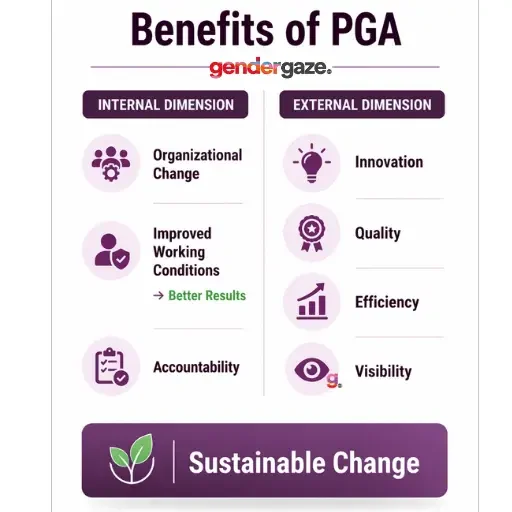
- Endogenous Transformation: Change is achieved through awareness from within, ensuring sustainable results.
- Enhanced Performance: Analyzing qualitative beliefs and standards impacts efficiency, quality, and productivity.
- Safety & Inclusion: Opinions are collected in an anonymous and safe environment, fostering a culture of trust.
- Strategic Benchmarking: Establishes a baseline to measure future progress in gender equality and diversity.
- External Reputation: Projects a gender-sensitive image to donors, partners, and the public.
FAQ
What is a Participatory Gender Audit (PGA)?
PGA is a assessment tool that helps organizations reflect on their internal gender capacity and identify good practices and challenges.It examines both objective structural elements and the subjective organizational culture to promote institutional learning
How does it differ from a traditional financial audit?
While traditional audits focus on rule compliance, a PGA is a “social audit” that encourages active participation from all employees and promotes collective ownership of gender equality outcomes. It focuses on organizational learning and sustainable change from within rather than external judgment.
Who can benefit from implementing a PGA?
The methodology is highly adaptable and benefits a wide range of entities, including private companies, NGOs, government ministries, and international organizations. It helps these institutions develop egalitarian workplace policies and measure the impact of their gender mainstreaming efforts.
How long does the entire process take?
The full process typically spans 6 to 8 weeks. This includes a home-based desk review of documents, a 1-to-2 week intensive on-site phase for interviews and workshops, and the final preparation of the audit report.
Will the audit "judge" or penalize my organization?
No; the audit is a participatory self-assessment where facilitators act as guides rather than “gender police”. The goal is to establish a baseline for progress and help the organization identify its own recommendations for improvement.
What tools are used to gather data?
The PGA uses a “triangulation” of sources to ensure accuracy: an extensive desk review of internal documents, semi-structured interviews, collective participatory workshops, and an anonymous staff survey.
Is the information shared by employees kept confidential?
Yes; protecting anonymity is a core principle of the PGA to ensure a safe environment for open discussion. Individual opinions are collected anonymously, and no employee is quoted by name in the final report.
What is the final result of the audit?
Get a tailored technical and financial proposal for a PGA adapted to your organization's size and goals
Consult an ILO-certified facilitator